
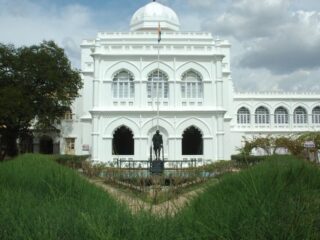
Madurai Gandhi Museum
Gandhi Museum is housed in the old Palace of Rani Mangammal, the Gandhi Museum depicts the highlights of the freedom struggle and contains a picture gallery of the Gandhian movement. Also can be seen are a gallery of relics, Khadi and village industries section and South Indian Handicrafts section.
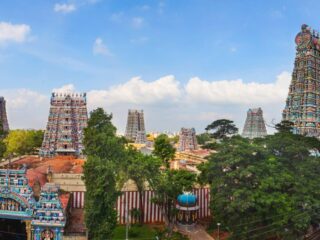
Sri Meenakshi – Sundareswarar Temple
Synonymous with Madurai is the Meenakshi Sundareswarar twin Temple, the pivot around which the city has evolved. The Meenakshi Temple complex is literally a city – one of the largest of its kind in India and undoubtedly one of the oldest too. The temple grew with the contribution of each dynasty and victorious monarchs, into an enormous complex extending over an area of 65000 Sq m. The temple first came in to being 2000 years ago and was substantially expanded during the regime of Thirumalai Nayak(1623-55 AD). Lord Siva in his incarnation as Sundareswarar and his fish-eyed spouse, Meenakshi, are enshrined in this twin temple. There are five massive gateways enclosing these two shrines. Even a casual visitor is fascinated by the many paintings and sculptures. A striking feature of the temple is the astonishing structure know as “Ayiramkaal Mandapam” or the Hall of Thousand Pillars and each pillar features high, ornate, bold sculptures that look life like. View from any angle these pillars appear to be in a straight line, an architectural masterpiece indeed In the outermost corridors are situated the matchless musical pillars carved out of stones. When it is tapped, each pillar produces different musical note. Timings : The temple is usually open between 0500hrs and 1230hrs and again between 1600 hrs and 21.30 hrs.
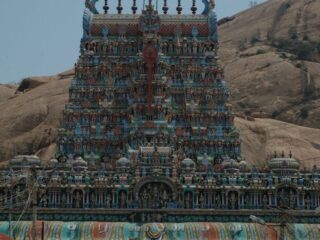
Thirupparankundram Temple
One of the six special abodes dedicated to Lord Murugan or Lord Subrahmanya is located 8 Kms South of Madurai. The importance of this temple is that the marriage of Lord Subrahmanya with Devayanai, the daughter of Indra, was celebrated here. The Cave shrines here are calculated as 8th century creation of the Pandiyans. The Sanctum Sanctorum is carved out of a single rock and the temple is believed to be in existence for many centuries. The walls and the pillars have fascinating carvings.
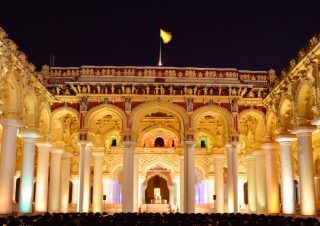
Thirumalai Nayak Palace
About 1.5 Kms from the Meenakshi temple, this palace was built in 1636 by the ruler whose name it bears. The imposing edifice is famous for the “Stuccowork” on its domes and impressive arches. The Sorgavilasam (Celestial Pavilion), measuring 75m x 52m, constructed entirely of brick and mortar without the support of a single rafter or girder, is a marvel of Indo-Saracenic architectural style. Among other striking features of the palace are the massive white pillars, several of which line the corridor that runs along the courtyard. Connected by high decorated arches, these pillars measure 20m in height and have a circumference of 4m. Elsewhere, there are polished black stone pillars of varying heights. It was King Thirumalai Nayak’s grandson who demolished much of the fine structure and removed most of the jewels and woodcarvings in order to build his own palace in Tiruchirapalli. (His dream never came true). Thanks to Lord Napier, the then Governor of Madras, who partially restored the palace in 1866-72, and the subsequent restoration works carried out several years ago, today, we get to see the Entrance Gate, The Main Hall and the Dance Hall. There’s daily sound and light show in English at 1845 hrs and in Tamil at 2015 hrs. This half an hour show extols the virtues of King Thirumalai, particularly his passion for arts, his victories in battle and his love for his subjects.